|
|
|
|
|
|
Applications of Focused Piezoelectric Spheres |
|
|
13 July, 2017 |
Piezo Ceramic |
|
|
|
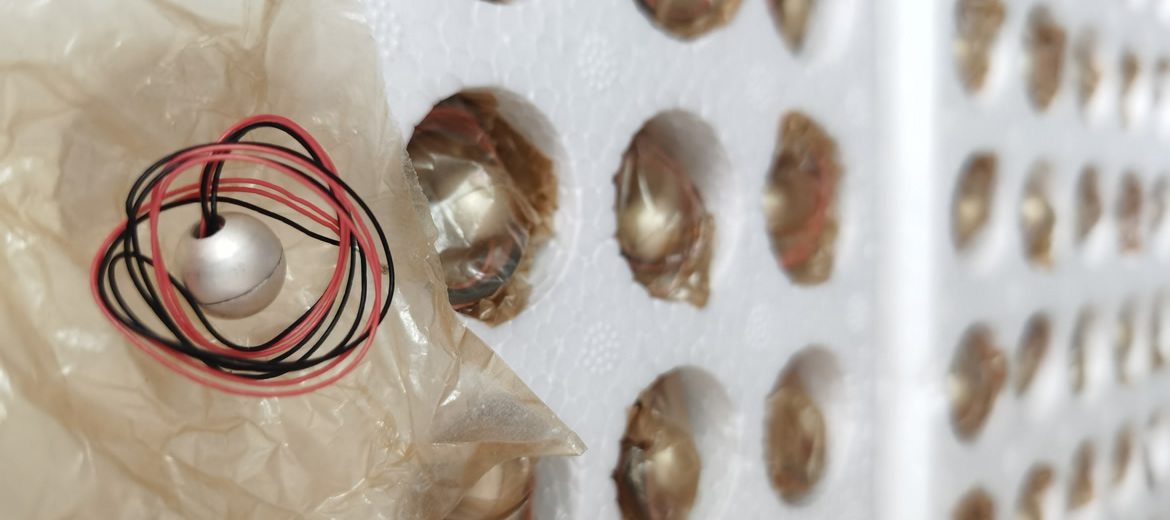
Piezoelectric hemispheres are functional elements that deeply couple the piezoelectric effect with spherical geometry. Their core value lies in using the electromechanical conversion property of piezoelectric materials, combined with the spherical shape, to achieve self-focusing of acoustic energy. This allows much higher sound pressure gain and spatial resolution than flat transducers, even with a limited aperture. The following discussion covers three aspects: working principle, types of piezos, and application areas.
Working Principle: Synergy of Geometric Focusing and Piezoelectric Effect
The operation of a focused piezoelectric hemisphere is based on two physical foundations: the piezoelectric effect and spherical wave focusing. In the electro-acoustic conversion stage (transmit mode), an alternating electric field applied to the electrodes on the inner and outer surfaces of the hemisphere excites the piezoelectric material (such as PZT-4 or PZT-5 ceramics) to produce thickness-mode or radial vibrations. Because of the curvature of the hemispherical shell, the vibration does not propagate in a single direction; instead, it radiates spherical waves toward the center of the sphere. In the acoustic focusing stage, the key is the self-focusing property of spherical geometry. According to Huygens’ principle, every point on the hemispherical surface generates a secondary wavelet. When these wavelets travel to the center, their path lengths are equal, so they arrive in phase and constructively interfere, creating a high-pressure focal region near the center. This self-focusing effect requires no extra acoustic lens or electronic phase-delay circuitry, making the structure simple and highly efficient. In receive mode (e.g., as a hydrophone), the principle is reversible: sound waves coming from the center direction reach the hemisphere surface in phase, exciting the piezoelectric material to produce a cumulative charge output, which significantly improves receiving sensitivity.
Types of Focused Piezoelectric Sphere Elements
Depending on the application requirements for aperture, focal length, and operating frequency, focused piezoelectric elements have evolved into three main shapes: hemispheres, hollow spheres, and focusing bowls.
Hollow sphere (complete spherical shell) – In theory, it has perfect full-space symmetry, enabling omnidirectional transmission or reception with no directivity. In low-frequency sonar, two piezoelectric hemispherical shells are often joined into a complete sphere and encapsulated in sound-transparent rubber to form a spherical transducer. Its radial vibration mode determines the resonant frequency, making it suitable for underwater communication and monitoring that require omnidirectional coverage.
Hemisphere – This is the most common form. It retains the spherical focusing capability while breaking the omnidirectional symmetry, thus producing a directional beam. Hemispheres are easy to mount on one side and to connect with electrode leads. In medical HIFU and therapeutic ultrasound, multiple piezoelectric hemisphere elements are often arrayed on a spherical-cap base, and electronic phase control is used to scan the focal spot. The frequency design of hemispheres is flexible; for example, a PZT-4 hemisphere with an outer diameter of 19 mm and a radius of curvature of 16.5 mm can have a thickness-resonance frequency of 7 MHz, suitable for superficial treatments.
Focusing bowl (also called piezoelectric arc shell or concave spherical shell) – This is essentially a shallow spherical shell with a radius of curvature larger than its height. Its focal depth is shallower, but the focal zone is wider, making it suitable for applications requiring large-area uniform irradiation or specific cavitation effects. Focusing bowls can be fabricated from 1-3 piezoelectric composites to reduce acoustic impedance mismatch and obtain a broader bandwidth.
Key Application Areas of Piezoelectric Spheres
1) Medical High-Intensity Focused Ultrasound (HIFU) and Therapeutic Ultrasound
This is the most representative application of focused piezoelectric hemispheres. HIFU uses spherically self-focusing piezoelectric transducers to concentrate high-power ultrasound onto a target inside the body (such as a tumor), generating transient high temperatures (>65°C) or cavitation effects at the focal point to achieve non-invasive ablation. In system implementation, a single-element hemisphere produces a fixed focal spot and is used for uterine fibroids or prostate treatments; while a hundreds-element composite spherical phased array represents the cutting edge. By adjusting the phase of each hemispherical element, the focal point can be electronically steered in three dimensions, enabling conformal treatment of deep-seated tumors. Sub-array switching techniques can also avoid rib obstruction. In addition, for targeted drug delivery and blood-brain barrier opening, focused ultrasound can trigger the rupture of drug-loaded microbubbles at the focal point, achieving site-specific drug release – a process that relies on the precise acoustic mechanical field generated by the piezoelectric hemisphere.
2) Sonar Transducers
In underwater acoustics, the demands on transducers are low frequency, high power, and omnidirectionality. Large piezoelectric ceramic hemispherical shells (e.g., 164 mm diameter, 4 mm wall thickness) made by isostatic pressing and special poling processes are joined into a complete sphere and packaged to form low-frequency (about 10 kHz) high-power sonar transducers, with transmitting sensitivity exceeding 140 dB and receiving sensitivity better than -188 dB. This spherical structure has nearly perfect omnidirectional directivity in the 8-12 kHz band, making it a core device for long-range underwater detection, communication, and navigation. Co-vibrating vector hydrophones also often use spherical structures, employing three-dimensional piezoelectric acceleration sensors to pick up pressure gradients, achieving low-frequency, high-sensitivity monitoring.
3) Hydrophones and Acoustic Measurements
In hydrophone applications, piezoelectric hemispheres mainly exploit their high sensitivity and broadband characteristics in receive mode. Because the spherical structure provides a consistent phase response to incoming waves from all directions, piezoelectric hemispherical hydrophones can be used for acoustic field calibration, measurement of sound pressure distribution in the HIFU focal region, and underwater noise monitoring. Miniature piezoelectric spheres offered by manufacturers such as PI (with outer diameters as small as 2 mm) can serve as miniature probe hydrophones for high-spatial-resolution field scanning, minimizing disturbance to the original acoustic field.
Through ingenious geometric design, focused piezoelectric hemispheres elevate the functional properties of piezoelectric materials into a system advantage of “structure-function integration.” From miniature medical probes of just a few millimeters to underwater sonar of hundreds of millimeters, from simple single-element fixed foci to complex spherical phased arrays, their applications consistently revolve around the core theme of “efficient focusing."Looking ahead, with advances in composite material processing and maturation of phased-array driving technologies, piezoelectric hemispheres will play an even more critical role in precision medicine and intelligent sensing.
|
|
|
« Back |
|
↑ Top |
|
|
|
|
 Home
Home Downloads
 Sitemap
 Contact